
They overlap, and many services use both. Trauma-informed care focuses on preventing re-traumatisation and understanding trauma impacts. PIE is broader operationally: it includes trauma-aware thinking and the service’s environment, relationships, staff support, reflective practice, and continuous learning.
Psychologically Informed Environments (PIE) at Emerge
A Psychologically Informed Environment (PIE) is a way of running a service that starts with a simple idea: how we design our spaces, how we relate to each other, and how we make decisions should make it easier for people to feel safe, stay engaged and make positive changes.
PIE grew out of UK work on improving services for people experiencing homelessness and complex needs, including guidance published by the Department for Communities and Local Government in 2012. Emerge adopts this framework because it fits what we believe creates real change: safety, dignity, consistency, and relationships you can trust.
We introduce PIE at Emerge using three practical commitments:
1) Relationships first. Consistent, well-boundaried, respectful relationships are the main “tool” of support.
2) Spaces that support. The physical and social environment is shaped to reduce stress and increase safety, dignity and belonging.
3) Learning, not blaming. We use reflective practice, training and evidence-gathering to understand what’s happening and keep improving.
Taken together, these commitments help us move away from “What’s wrong with you?” and towards “What happened, what do you need, and what will help right now?”
What is PIE in simple terms?
PIE is not a therapy programme and it’s not a single set of rules. It’s a service approach: a shared way of thinking and working that recognises people’s behaviour makes sense in context.
Many residents have experienced loss, trauma, exclusion, instability or repeated disappointments from systems that were meant to help. When those experiences stack up, everyday situations can feel threatening or overwhelming, and people may cope in ways that look “challenging” on the surface. That’s not a character flaw. It’s often an understandable response to pressure.
A PIE helps staff respond differently. Instead of relying on crisis management, punitive responses or constant rule-enforcement, we try to understand the emotion underneath the behaviour and respond in a calm, consistent and planned way. The goal is to make the service easier to use, easier to trust and more likely to support lasting change.
Why Emerge has chosen PIE
Emerge exists to provide a stable base from which residents can move forward. A psychologically informed approach supports that mission because it focuses on the conditions that make change possible: safety, predictability, dignity, connection and a sense of control.
In many accommodation settings, the most stressful moments are not “big events” but small, repeated pressures: uncertainty about what will happen next, misunderstandings, conflict in shared spaces, or feeling judged when you’re already stretched. PIE is designed to reduce these friction points.
It helps us:
-
create routines and expectations that feel fair and consistent
-
build trust over time, especially where trust has been broken before
-
avoid unnecessary escalation and reduce avoidable exclusions
-
support staff wellbeing so the service stays calm and reliable
Put simply: when the environment is calmer and relationships are stronger, residents have more space to focus on their goals.
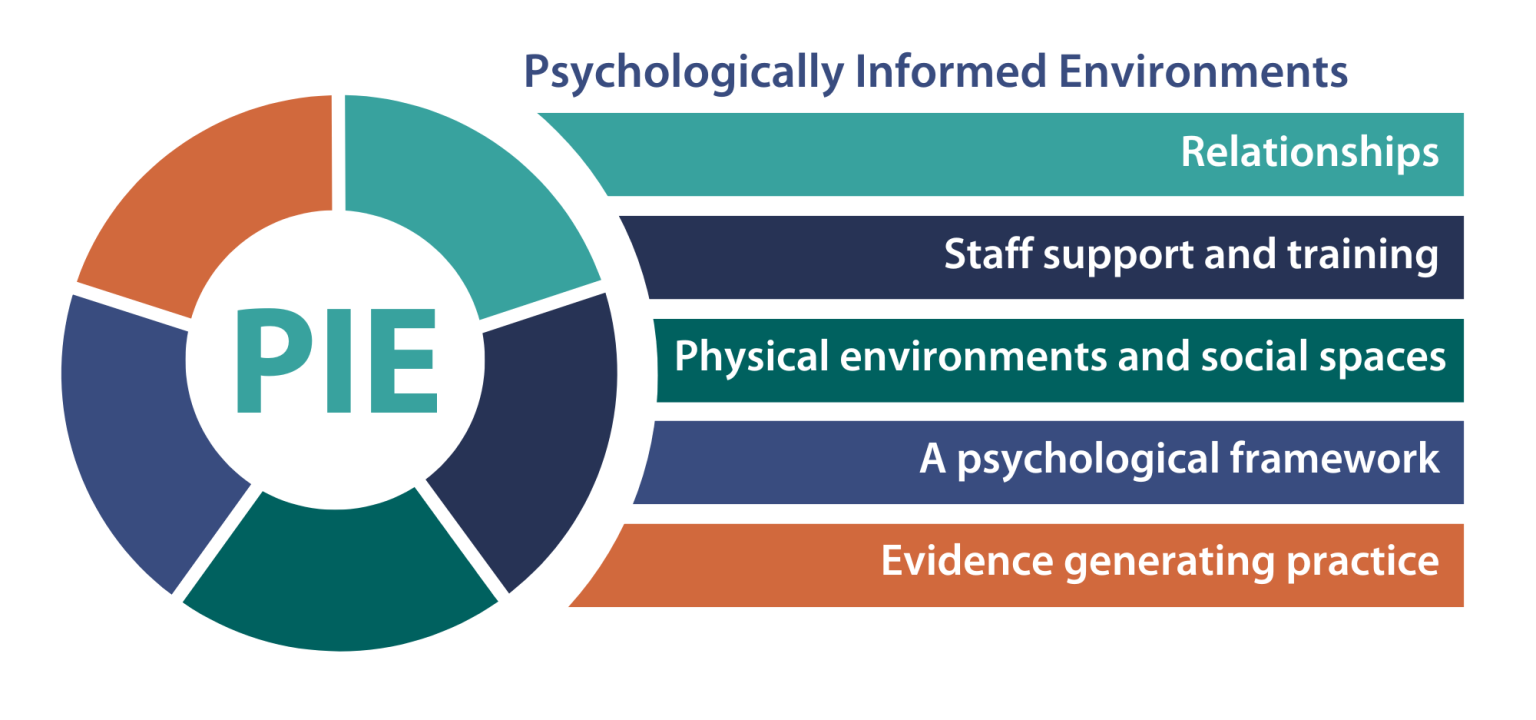
The five core elements of PIE (and what they look like at Emerge)
Different organisations describe PIE in slightly different ways, but most UK guidance points to five core elements. Here’s what they mean, and how they show up in practice.
1) Relationships
In PIE, relationships are not “a nice extra” — they are central. Change usually happens in the context of a trusting relationship where someone feels seen, respected and safe enough to take small risks.
At Emerge, that means:
-
Consistency: residents know who they can speak to and what support is available
-
Boundaries with warmth: clear expectations, delivered respectfully and without shaming
-
Repair after rupture: when things go wrong, we focus on making things right, not writing people off
-
Everyday contact: brief, regular check-ins that build connection over time (not just meetings in a crisis)
A relationship-led approach also means we pay attention to power. Staff have responsibilities and residents have rights. We aim for “with you” rather than “to you”.
2) Staff support and training
A PIE depends on the people delivering it. Working alongside residents who are under pressure can be demanding and emotionally absorbing. Without good support, staff can drift into burnout, rigid rule-enforcement or emotional distancing — not because they don’t care, but because they’re overwhelmed.
At Emerge, we invest in staff support and training so the service stays steady:
-
Shared understanding: staff have a common language about trauma, attachment, boundaries and emotional regulation
-
Supervision and reflective spaces: regular time to think, not just do
-
Peer learning: teams learn from what’s working across shifts and sites
-
Attention to staff wellbeing: because the emotional tone of the service starts with the people who hold it
When staff feel supported, residents experience more consistency, patience and fairness.
3) The physical environment and social spaces
PIE recognises that buildings and routines can either increase stress or reduce it. Lighting, noise, privacy, signage, queueing, the layout of communal spaces, and even the tone of notices on the wall can all shape behaviour.
At Emerge we try to make the environment communicate: “You are safe here, you matter here, and you can find your way around.” Examples include:
-
Clear, predictable spaces: good wayfinding, easy-to-understand information, predictable access to staff
-
Privacy and dignity: where possible, spaces for quiet, confidential conversations and time out
-
Thoughtful communal areas: spaces that support positive interaction, not constant conflict
-
A trauma-aware lens: noticing triggers (for example, crowded corridors or unclear rules) and adapting where we can
We also recognise the “social environment” matters as much as the physical one. The culture of the service — how people speak to each other, how conflict is handled, what gets celebrated — is part of the environment too.
4) A psychological framework
A psychological framework is the shared set of ideas that helps a team make sense of what’s happening. It’s not about diagnosing residents. It’s about understanding patterns: how stress affects thinking, how trauma affects trust, how shame affects communication, how routines affect regulation, and why change can be hard even when someone wants it.
In practice, this means staff ask questions such as:
-
What might this behaviour be communicating?
-
What need is underneath it (safety, control, connection, relief, respect)?
-
What’s the smallest step that could make things feel more manageable today?
-
How do we respond in a way that reduces harm and supports learning?
Having a shared framework reduces “mixed messages” between staff and helps residents experience a more predictable service.
5) Evidence-generating practice
PIE is a learning approach. We don’t assume we’ve “got it right” just because we’ve adopted a framework. We gather feedback, notice patterns and adjust.
At Emerge, evidence-generating practice includes:
-
Resident voice: feedback in multiple forms (informal conversations, groups, surveys, complaints and compliments)
-
Outcome tracking: engagement with support, tenancy sustainment, planned move-on, incidents and repairs, safeguarding themes
-
Learning reviews: when something goes wrong, we look at contributory factors and improve the system
-
Transparency: residents can see how feedback has influenced changes (“you said / we did”)
This is also where PIE links to quality improvement: small changes, made consistently, add up.
How PIE works day-to-day
PIE can sound abstract until you see it in everyday interactions. Here are some examples of what it changes in practice.
Predictability beats surprises
Many people cope better when the service is predictable. We aim to be clear about what will happen, when it will happen and who will be involved. That might mean:
-
explaining processes up front (what an appointment is for, how long it will take, what information is needed)
-
giving choices where possible (time of a meeting, who is present, where you sit)
-
using consistent language across the team so residents don’t get contradictory messages
De-escalation is everyone’s job
When someone is distressed, the priority is safety and calming, not winning an argument. Staff use tone, pacing and respectful boundaries to reduce escalation.
After the moment has passed, we return to problem-solving together: what happened, what helped, and what we can do differently next time.
“Do with” rather than “do for” (or “do to”)
Support is most effective when residents have ownership. PIE encourages practical collaboration: breaking goals into steps, agreeing what each person will do, and celebrating progress.
It also means we are careful not to take over in ways that reduce confidence or control. Support should build capability, not dependency.
Boundaries are support, not punishment
Clear boundaries help people feel safe when they are delivered fairly and consistently. PIE does not mean “anything goes”. It means rules exist for a reason, are explained in human terms, and are applied in a way that aims to keep people engaged rather than pushing them out.
Where consequences are needed, we aim for proportionate responses and learning — and we focus on restoring safety and expectations, not humiliation.
Repair is built in
Everyone has hard days. In a PIE, an incident is not the end of the relationship. We prioritise repair: checking in afterwards, acknowledging impact, offering a route back to safety and expectations, and supporting the resident to reflect without shame.
What residents can expect from a PIE at Emerge
Every resident is different, and everyone’s goals are different. PIE is about making the environment supportive for that variety.
In practical terms, residents can expect:
-
Respect and dignity: being spoken to like a person, not a “case”
-
Consistency: clear expectations, communicated calmly and applied fairly
-
Choice and collaboration: involvement in decisions that affect day-to-day life
-
A strengths focus: noticing what’s going well, not only what’s going wrong
-
Support that fits: adapting how we communicate and plan, based on what helps you engage
-
A calmer culture: staff working to reduce conflict, not add to it
We also take confidentiality and safeguarding seriously, and we work with partner services when specialist input is needed.
Why PIE benefits residents
PIE is adopted because it improves the conditions for recovery and stability. While outcomes vary, a psychologically informed approach aims to support residents to:
-
feel safer and more settled in their accommodation
-
reduce day-to-day stress and conflict in shared spaces
-
build trusting relationships and communication skills
-
strengthen emotional regulation and coping strategies
-
stay engaged with support long enough for change to stick
-
sustain a tenancy and move on in a planned way, when ready
It also benefits residents indirectly by supporting staff wellbeing and reducing turnover — which helps keep the service consistent.
PIE and clinical support: what it is, and what it isn’t
It’s important to be clear: PIE is a service approach, not a substitute for clinical mental health care. Staff are not providing therapy unless they are specifically qualified and commissioned to do so.
The role of PIE is to make Emerge a place where people can engage, feel safe and access the right support — including referral routes into health services where appropriate.
This clarity protects residents and staff. It also reinforces a key principle: people can’t benefit from help they can’t tolerate. PIE improves the “tolerability” of support by reducing shame, chaos and unnecessary conflict.
How we know it’s working
The evidence base for PIE is still developing: it’s widely adopted across homelessness and supported housing services, but there are gaps in high-quality outcome studies. That’s one reason PIE emphasises evidence-generating practice — learning from real-world delivery, in a structured way, and improving over time.
At Emerge, we look for:
-
resident feedback about feeling safer, more respected and more able to engage
-
reduced incidents, conflict and unplanned endings
-
improved engagement with keywork and support plans
-
increased planned move-on and tenancy sustainment
-
staff wellbeing indicators (because a stable team benefits residents)
We also review learning after difficult events, and we make changes to policy, environment and practice accordingly.